

Blog
Define Your Exit Before Your Entry: Know Where You're Wrong
If you can't say where the trade is wrong before you click buy, you don't have a trade yet. Here's how to find that price, and why everything else depends on it.
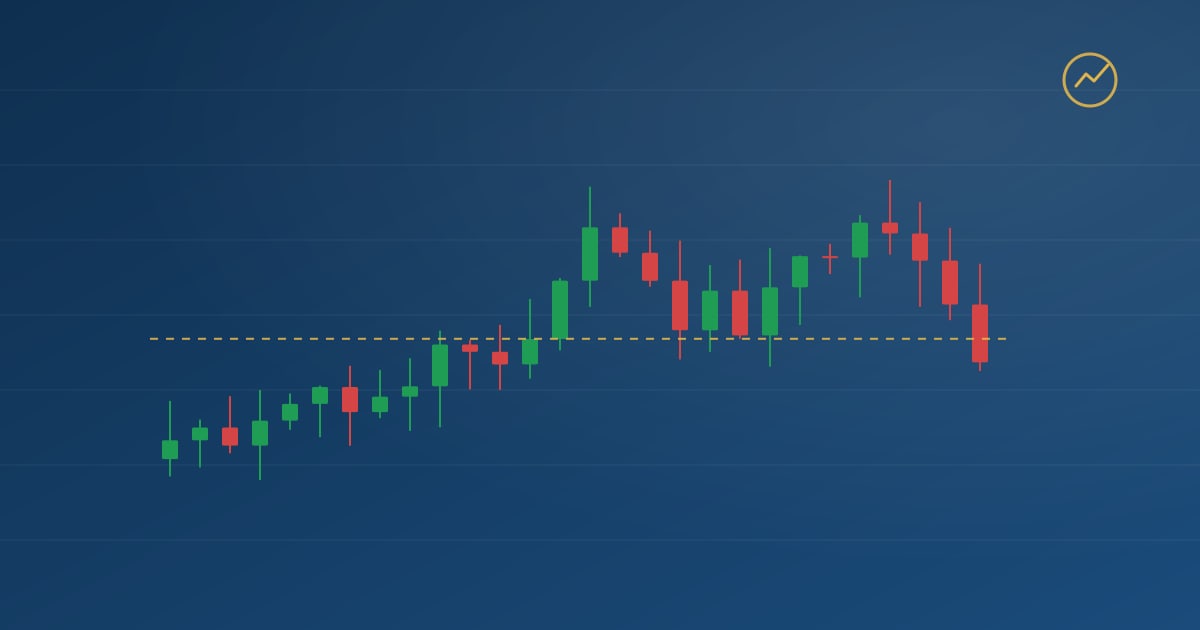
Every trade has two prices that matter before it starts. Where you get in, and where you admit it didn’t work. Most people pour all their attention into the first one and find out the second in real time, with money already on the line.
So the tip is short: decide the exit before the entry. It’s first on our list because nearly everything else in risk management hangs off it.
What “where I’m wrong” means
Your exit isn’t a guess at how far the trade might go against you. It’s the price at which the reason for the trade stops being true.
Bought because a support level held? You’re wrong when price closes below it. Bought a breakout? You’re wrong when price closes back inside the range. Bought a hammer? You’re wrong below the hammer’s low, because that’s where the buyers who made the pattern got overrun.
In each case the exit comes off the chart. A stop set at “5% below entry” has nothing to do with the idea you’re testing. It’ll get hit by noise on some trades while the idea is still fine, and sit far too wide on others.
Why this is the line between trading and gambling
A bet with no exit is a bet on being right. A trade with a defined exit is a bet with a known cost. Known costs can be sized, repeated and added up. Unknown ones can’t.
That’s the whole distinction. The gambler’s downside is open-ended and comes with a story about why it’ll come back. The trader’s position has a price where the story ends. Both might be wrong about direction just as often. Only one survives it.
There’s a practical payoff too. Risk per share is the distance from entry to exit, and share count is your risk budget divided by that distance. No exit, no share count. You end up choosing size by feel, which is how most large losses start.
A worked example
Say you’re looking at a stock that has bounced off $48 twice in the past two months and is sitting at $50 with a clean reversal candle. The level is the reason for the trade. If price closes under $48, the level didn’t hold and you were wrong.
So the stop goes just under $48, call it $47.60 to leave room for a probe. Risk per share is $2.40. If your budget is $250 a trade, that’s 104 shares. Notice you found the exit before you ever thought about the share count, and the share count came out of arithmetic rather than mood.
Now flip it. Suppose the same chart has no level nearby, just a candle you like in the middle of nowhere. Where’s the stop? If you can’t answer that from the chart, there’s no trade. That outcome isn’t the method failing. It’s the method working.
How to do it every time
- Find the level the trade depends on before you look at the entry. A prior swing low, a range boundary, an average that’s been respected twice.
- Put the stop a little beyond it. Levels get probed, so give it room.
- Measure entry to stop. That’s your risk per share; feed it into the position size calculator for the share count.
- Enter the stop as a live order when you enter the trade. A mental stop is a promise to be disciplined later, at the exact moment you won’t feel like it.
What changes
Your losses get boring, which is the goal. They land near the size you planned, they stop being emotional events, and they become data you can add up. Your journal starts to mean something, because every result can be checked against an intent you wrote down first.
You’ll also pass on more trades, because a surprising number of tempting charts have no honest exit. That’s the filter doing its job.
The risk management guide covers the arithmetic from scratch, and support and resistance covers finding the level that gives you the exit.
Frequently asked questions
What does it mean to define your exit before your entry?
Before you buy, you decide the price at which the trade is wrong and you'll sell. You take it from the chart, usually just beyond the level the whole trade depends on, and it goes in as a stop order at the same time as the entry.
Where should the exit go?
At the price that proves the idea failed. Below the support you bought against, back inside the range you bought the breakout of, under the low of the reversal candle. A fixed percentage below entry has nothing to do with the idea, so it just gets hit by noise.